
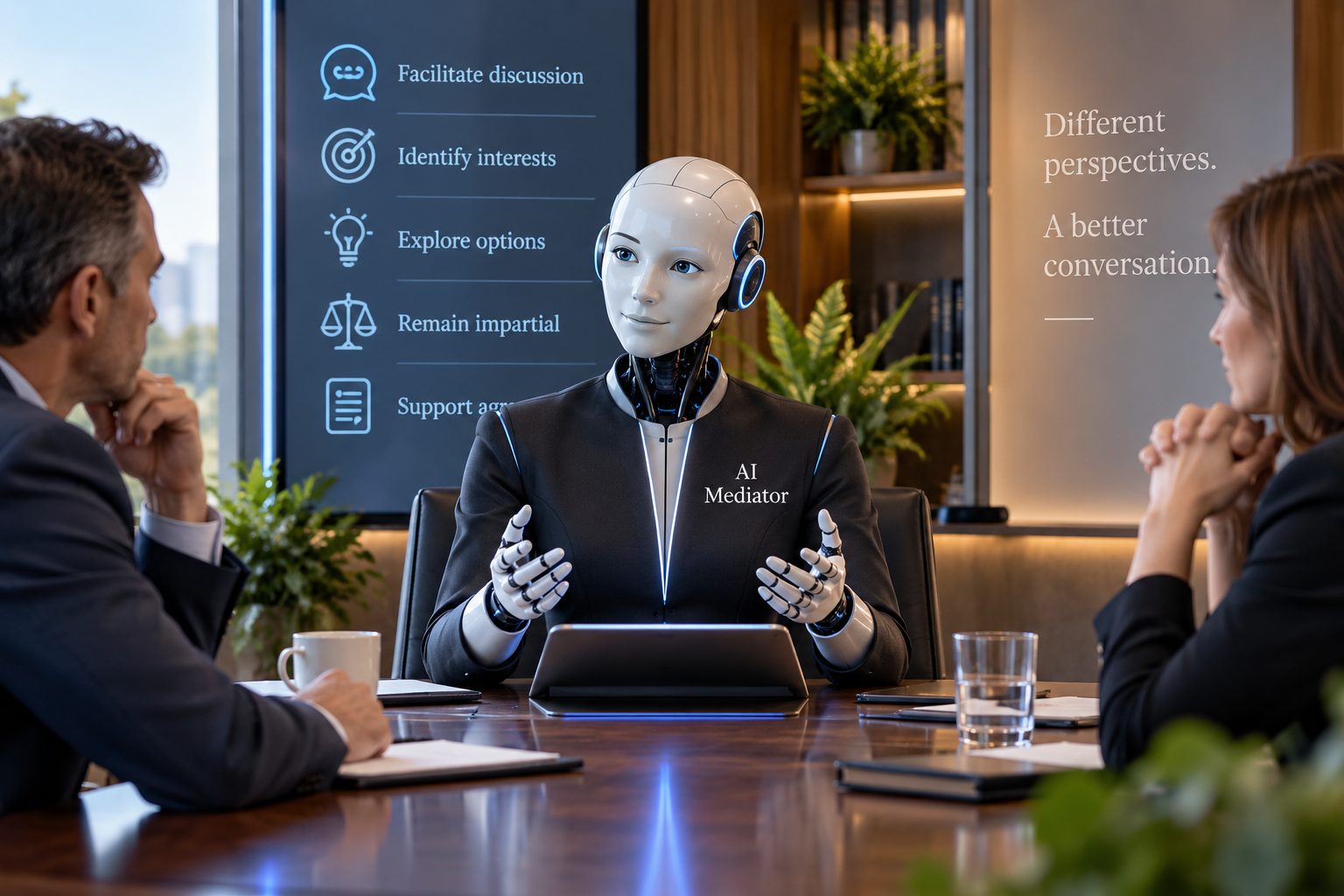
Artificial intelligence is already changing legal practice. It can summarise documents, analyse information, produce chronologies, generate possible arguments and help draft agreements.
So what about mediation?
Could AI assist a mediator — or even become the mediator?
The answer requires some care. There are perfectly legitimate and potentially valuable uses of AI within mediation. But mediation also depends upon qualities which make unrestricted use of AI particularly problematic: confidentiality, trust, impartiality, judgement and the ability to understand what people actually mean rather than simply what they say.
The sensible question is therefore not whether AI should be “allowed” into mediation.
It is:
“Which tasks can AI perform safely and effectively, and which should remain the responsibility of the human mediator and the parties?”
AI as an assistant, not necessarily the mediator
There is an important distinction between using AI within a mediation and allowing AI to conduct the mediation.
A mediator might legitimately use appropriate technology to assist with administrative or analytical work while remaining personally responsible for the mediation.
Potential uses include:
- organising large quantities of information;
- producing chronologies;
- identifying issues from position statements;
- comparing competing calculations;
- helping analyse possible settlement structures;
- drafting neutral agendas or lists of issues;
- checking draft settlement wording for internal consistency; and
- assisting with administrative tasks before and after the mediation.
Used properly, this may allow the mediator to spend less time processing information and more time doing what mediation requires: listening to people, identifying interests, testing assumptions and helping parties negotiate.
Preparing for mediation
One of the clearest legitimate applications is preparation.
Commercial mediations can involve substantial bundles of contracts, correspondence, expert evidence, pleadings and financial information.
AI tools may be capable of helping to organise that material and identify recurring themes or inconsistencies.
For example, a mediator faced with several hundred pages of documents might use an appropriately secure system to help produce a chronology or identify where the parties disagree about particular events.
But there is an important qualification.
The mediator must still know the case.
An AI-generated summary cannot safely become a substitute for reading the important documents. Generative AI can misunderstand context, omit qualifications and, most importantly, confidently produce information which is wrong.
The mediator remains responsible for the mediation.
Helping identify interests
Mediation is not simply about legal positions.
A claimant may say:
“I want £250,000.”
The defendant may say:
“We will not pay more than £75,000.”
Those are positions.
The underlying interests may be much more complicated: cash flow, reputation, confidentiality, maintaining a commercial relationship, avoiding management time, achieving certainty or bringing an emotionally exhausting dispute to an end.
AI may help organise information and suggest questions which a mediator might consider.
But identifying the real interests of human beings requires something more.
It requires conversation.
A pause, hesitation or apparently incidental comment may tell an experienced mediator more than several pages of written submissions.
That is an area where human judgement remains central.
Reality testing
One of the mediator’s functions is often to reality-test a party’s position.
AI can potentially assist with the analytical component of that exercise.
It might help model different outcomes:
What happens if the claimant wins 60% of the claim but fails on another issue?
What are the potential costs consequences of proceeding to trial?
How does an offer compare with a range of possible litigation outcomes?
What would different payment structures look like?
That can be useful.
But AI should not be presented to parties as an oracle.
An AI system’s assessment of a legal dispute is not a judicial determination. Its output depends upon the information supplied, the quality of the model and the assumptions underlying the question.
The phrase “the AI says you will lose” has no proper place in mediation.
Generating settlement options
AI may also be useful for brainstorming.
Many disputes are capable of solutions which go beyond one party paying money to another.
There may be instalment arrangements, revised contractual terms, future work, changes to procedures, transfers of property, confidentiality arrangements, apologies or mechanisms for resolving future disagreements.
An AI system can potentially generate possible structures for consideration.
That is very different from allowing the system to decide what the settlement should be.
The parties must retain control.
One of the fundamental characteristics of mediation is party autonomy. The settlement belongs to the parties, not to the mediator and certainly not to an algorithm.
Drafting settlement agreements
AI may also assist with drafting.
At the end of a successful mediation, considerable work can sometimes be required to turn a commercial agreement into precise written terms.
AI may help identify inconsistencies, produce initial wording or compare successive drafts.
But this is an area requiring particular caution.
The consequences of defective settlement drafting can be serious. The parties and their lawyers must therefore check the agreement carefully and satisfy themselves that it accurately records the settlement and has the intended legal effect.
AI can assist the drafting process.
It should not replace legal responsibility for the document.
The confidentiality problem
Perhaps the most important issue is confidentiality.
Mediators routinely receive highly sensitive material: settlement proposals, financial information, privileged documents, personal information and confidential explanations given privately by one party which must not be disclosed to another.
Uploading such material indiscriminately into a public or consumer AI system may create obvious problems.
Before using AI with mediation material, consideration should therefore be given to matters including:
- where the information is processed;
- whether it is retained;
- whether it may be used to train a model;
- who can access it;
- what contractual protections apply;
- whether personal data is involved;
- whether the parties have been told about the proposed use; and
- whether the use is compatible with the mediator’s confidentiality obligations.
The fact that an AI tool is convenient does not override those obligations.
Transparency and consent
There is also a question of transparency.
If AI is being used merely for mundane administrative purposes, the implications may be limited.
But if confidential mediation documents are to be analysed by an external AI system, the position is quite different.
A sensible principle is:
“The more substantive the AI’s involvement, and the more confidential the information being processed, the stronger the case for transparency and informed agreement about its use.”
Parties should not discover afterwards that sensitive material from their mediation was supplied to an AI service in circumstances they did not understand.
Trust is fundamental to mediation.
Private sessions create a particular difficulty
The mediator’s duty to preserve the confidentiality of separate meetings creates another important boundary.
A party may tell the mediator something privately and expressly prohibit its disclosure.
An AI system analysing material from both sides could potentially blur that separation unless it is configured and used with considerable care.
The human mediator understands that information obtained in one room cannot simply migrate into another.
Any technological system used during mediation must preserve the same distinction.
Bias and hallucination
AI systems can make mistakes.
They can also reproduce biases contained within training data or respond differently depending upon how a question is framed.
That matters if AI is used to assess the strength of arguments, generate settlement ranges or characterise the behaviour of the parties.
A polished answer is not necessarily a correct answer.
Mediators therefore need sufficient understanding of the technology to recognise its limitations.
The danger is not usually an obviously absurd output.
It is a plausible but incorrect one.
Could an AI actually mediate?
For some relatively standardised disputes, automated negotiation systems may increasingly assist parties to reach agreement.
But complex mediation involves considerably more than processing competing offers.
Human mediators deal with anger, mistrust, embarrassment, commercial realities, personalities, relationships and information which emerges gradually during the day.
They also exercise judgement about when to challenge, when to listen, when to remain silent and when to change direction entirely.
AI may become increasingly sophisticated at supporting those activities.
Whether parties will entrust the whole process to a machine is a different question.
For the foreseeable future, the more compelling model may be:
“AI-assisted mediation rather than AI replacing the mediator.”
A useful tool with clear boundaries
Mediators should neither ignore AI nor adopt it uncritically.
Used appropriately, it can help organise information, analyse figures, generate options and reduce time spent on routine tasks.
But several principles should remain clear:
Confidentiality must be protected.
AI-generated information must be checked.
The parties should understand significant uses of AI involving their information.
The mediator remains responsible for the process.
The parties remain responsible for their settlement.
And, perhaps most importantly:
“Technology should support the human conversation, not replace it.”
The purpose of mediation is not simply to process a dispute efficiently.
It is to help people resolve it.
ProMediate and technology in dispute resolution
ProMediate provides civil and commercial mediation for businesses and individuals in a wide range of disputes.
We recognise that artificial intelligence can provide useful tools for modern dispute resolution, but that its use must be consistent with confidentiality, transparency, data protection and the fundamental principle of party autonomy.
The future of mediation may well involve AI. The challenge is to use it where it improves the process without losing the human qualities which make mediation work.

About the author
Peter Causton
Director of ProMediate (UK) Limited — Commercial, Civil & Workplace Mediator
Founder and Director of ProMediate. An experienced independent commercial, civil and workplace mediator registered with the Civil Mediation Council, with over 100 mediations conducted since qualifying in 2009.
View Peter’s profileNewsletter
Stay informed
Receive practical guidance, mediation news, dispute resolution insights and updates from ProMediate.
- Commercial mediation
- Workplace mediation
- ADR developments
- Practical dispute resolution guidance
By subscribing you agree to receive ProMediate's email newsletter and updates. Usually monthly. You can unsubscribe at any time. See our Privacy Policy.
Suggested reading
Related areas of expertise
Mediators for this work


How we can help
Newsletter
Stay informed
Receive practical guidance, mediation news, dispute resolution insights and updates from ProMediate.
- Commercial mediation
- Workplace mediation
- ADR developments
- Practical dispute resolution guidance
By subscribing you agree to receive ProMediate's email newsletter and updates. Usually monthly. You can unsubscribe at any time. See our Privacy Policy.
Considering mediation in a commercial dispute?
ProMediate’s experienced human mediators help businesses and individuals resolve civil and commercial disputes confidentially, before or during litigation, in person or online.